Malatang Is Everywhere in Young Seoul. My Coworkers in Their 40s Still Don’t Eat It.
The first time I went to a malatang restaurant, I didn’t know how much to put in the bowl. I put in way too much. It was enough for two or three people. It came to almost 30,000 won.
In Seoul, the neighborhoods that have malatang are fixed. Hongdae, university areas, anywhere young people gather. In those places there is one on every block. In office districts there are almost none.
As a franchise business it is national. The biggest chain has grown past 500 stores. Two more sit somewhere over 100 each. Counting only those three, more than two new shops opened every week. Open a delivery app and the list does not end.
But I cannot think of many people in their 40s around me who eat it.
It is not common for one city to split like this by age over a single dish. Especially a dish that was not here to begin with.
And it is not Korean food. It is Sichuan Chinese. The biggest malatang chain in Korea is a Chinese company with around 3,600 stores worldwide.
Ten years ago nobody ate it
Until the early 2010s malatang was almost unknown in Korea. Even in Daerim-dong, where many Korean-Chinese live, Koreans mostly did not eat it. Then from around the mid-2010s, restaurants serving Chinese residents and Chinese students grew, and the name started to spread.
Ten years from that to a national franchise.
How it got in
Most articles explain it with social media and Gen Z curiosity. I think something came before that.
Korea takes in a lot of Chinese students. And more Korean students started going to China.
When you live somewhere for a few years your palate changes. The Chinese food Koreans grew up with is jjajangmyeon and jjamppong, and those were invented here. In China they either do not exist or taste nothing alike.
The restaurants were already there. They were built for Chinese customers. What changed is that Koreans started walking in.
And the timing was right
Korea was in the middle of a spicy food boom. It still is.
But mala is not the heat we knew. It is not chili heat. It is the tingle of Sichuan peppercorn. Your tongue does not burn, it goes numb. It is closer to a pain signal than a taste.
For people who had been eating spicy food for years, this was a new kind of stimulus. Something the old heat was not reaching.
Why it stayed is a different question
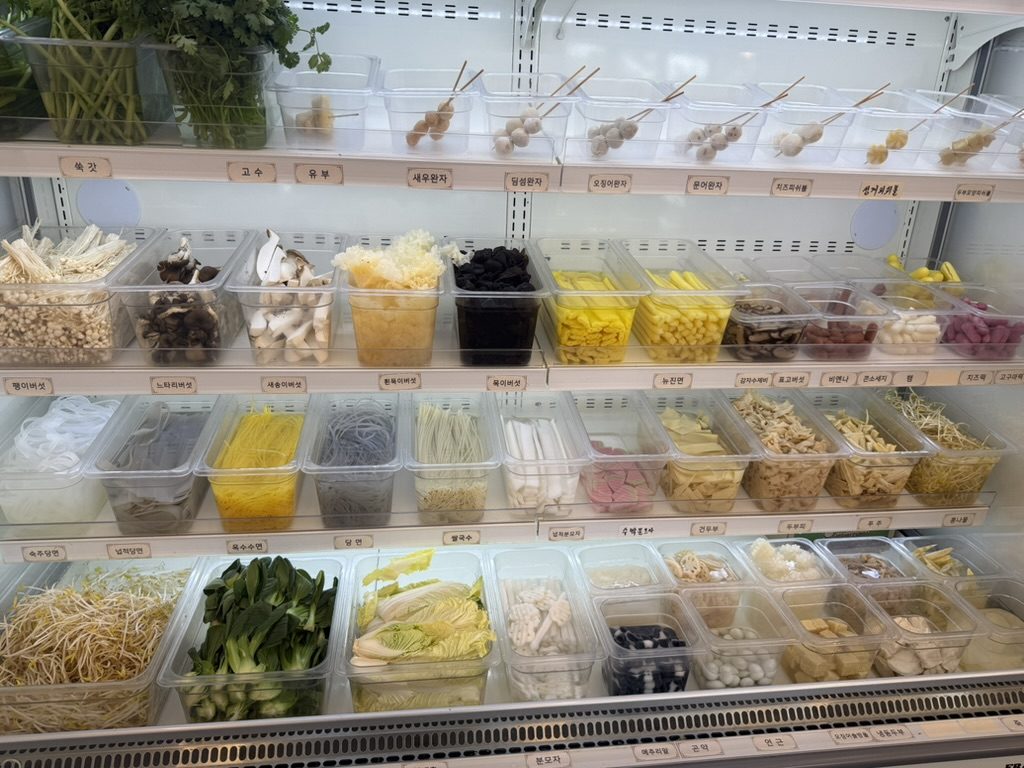
If students opened the door, what kept it open is how different it is from a normal Korean restaurant.
You pick your own ingredients. It is priced by weight. You choose the spice level. So you can eat something different at the same shop every time, and you control the budget yourself.
People now have more things they cannot eat, or will not. But in a Korean restaurant it is hard to order around your own preferences. Kimchi jjigae is kimchi jjigae. Asking them to leave out the garlic, or swap the scallions for mushrooms, feels awkward.
Malatang is different. You are putting it in the bowl yourself, so there is nobody to feel awkward with.
How to order
Take the tongs and fill your bowl. I usually put in about ten things.
They weigh it. That is your price.
You choose the spice level. It differs by shop but usually three to five steps. I usually go with the middle one.
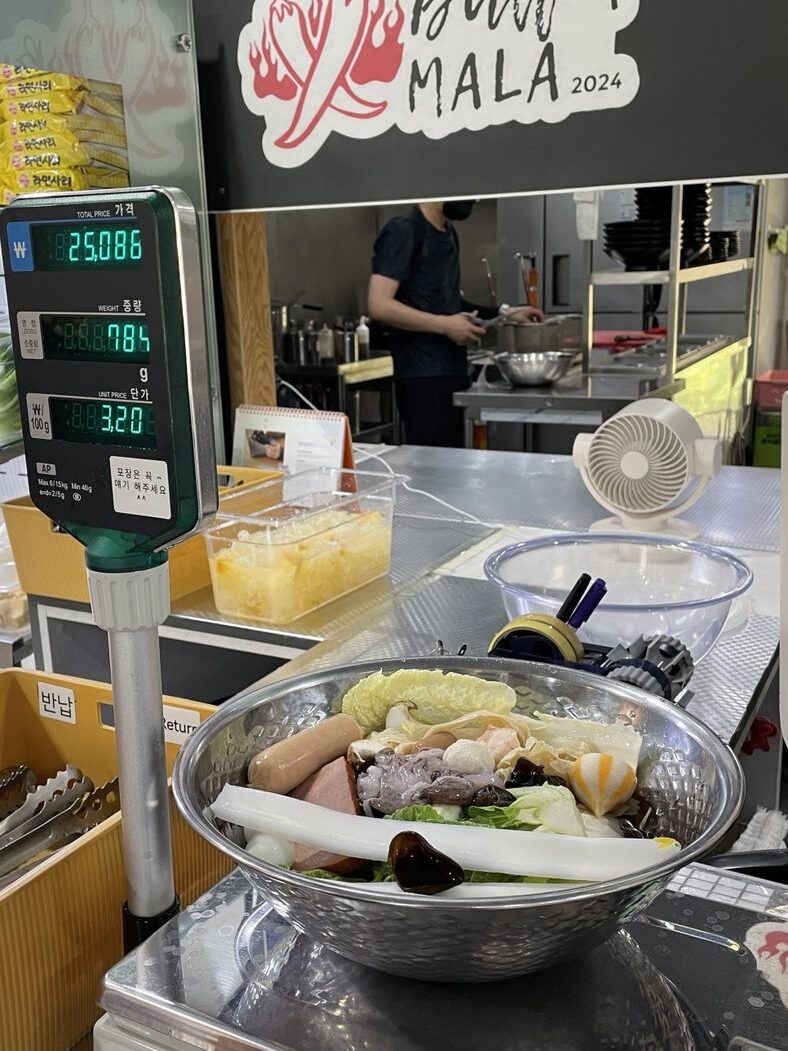
With meat added it comes to about 10,000 to 13,000 won. Mala xiang guo, the stir-fried version without broth, costs more. The bowl in the photo was 785g. That is about two servings.
Mala went into everything
Mala ramyeon, mala jjamppong, mala chicken, mala tteokbokki, mala chicken feet. There is mala budae jjigae. Budae jjigae came out of the Korean War, and now it has Sichuan spice in it.
When Outback put out a mala version of their Toowoomba pasta, it was settled. This was not a trend. A flavor category had been added.
Though these are aimed at young people too. Nobody in their 40s asked for them.
The flavor spread across the country. The people eating it haven’t.